
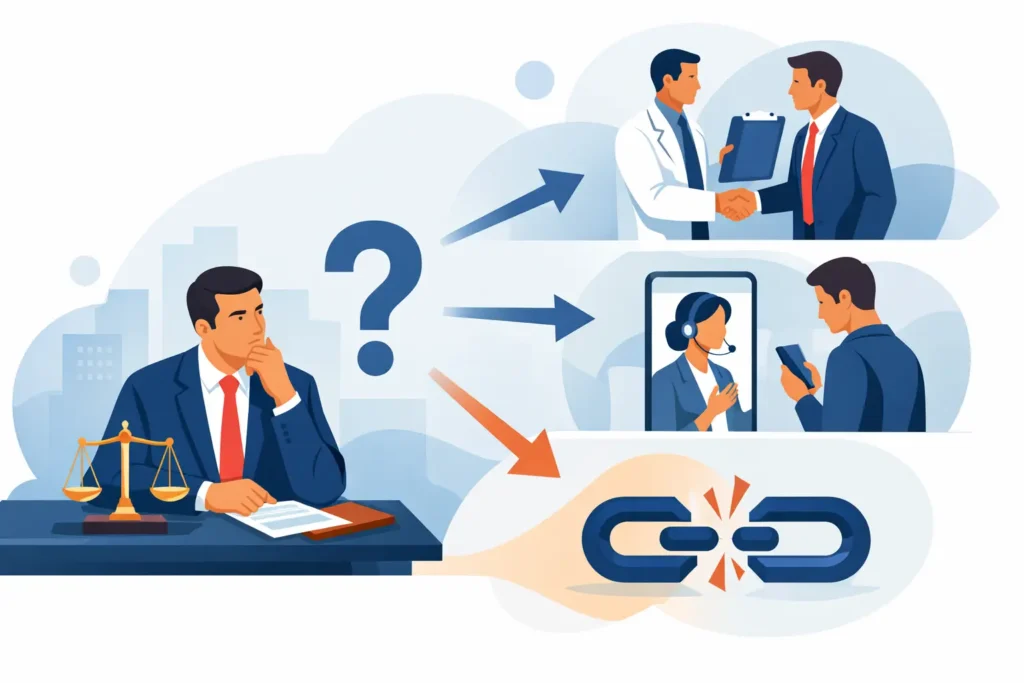
Your Google Ads bill arrives every month, right on schedule. Referrals do not. One month, your intake team is busy with friend-of-a-friend cases. The next, the phone goes quiet and you respond by buying more expensive clicks. If you are asking, why are referrals inconsistent, the answer is usually not that your clients were unhappy. It is that your firm has mistaken occasional goodwill for a referral system.
Personal injury firms do not need more vague advice about “staying in touch.” They need a deliberate process that turns a successful client outcome into a repeatable source of introductions. Without one, referral volume will always be hostage to memory, timing, and luck.
Why Are Referrals Inconsistent? Your Firm Is Not Controlling the Trigger
A former client can genuinely appreciate your work and still never send you a case. That is not a contradiction. It is normal human behavior.
People refer when three conditions line up: they remember you at the right moment, they feel confident recommending you, and making the introduction feels easy. Most PI firms leave all three conditions to chance. They close the file, send a generic review request, maybe add the client to a newsletter, and call that referral marketing.
That is not a system. It is passive hope dressed up as follow-up.
Your client is not thinking about your firm every week. They are thinking about getting back to work, managing bills, caring for family, and moving on from the accident. Then a coworker gets rear-ended, a neighbor slips at a store, or a relative is hit by an uninsured driver. In that moment, the client must instantly recall your name, understand the type of case you handle, and know what to say. If your firm has not prepared them for that moment, the referral often goes to the lawyer with the biggest billboard, the most familiar TV ad, or the friend who happened to mention a name first.
The problem is not referral intent. The problem is referral recall.
The Four Revenue Leaks Behind an Unpredictable Referral Pipeline
1. You ask at the wrong emotional moment
Many firms ask for referrals in the final case-closing email. That is convenient for the firm, but convenience is not strategy.
A client may be relieved when a case resolves, but resolution can also bring anxiety: medical balances, future treatment, taxes, lost wages, or the simple letdown of a long process ending. A one-line request for referrals buried beside settlement paperwork is easy to ignore.
The better question is not, “When can we ask?” It is, “When does the client most strongly feel the value we delivered?” For some clients, that happens after a difficult insurance issue is solved. For others, it happens when they receive a check, get an update that restores control, or realize your team treated them like a person rather than a file number. Referral conversations should be tied to meaningful value moments, not arbitrary administrative milestones.
2. Your request creates social risk
Clients will not enthusiastically recommend a firm if they fear their friend will have a poor experience. This is especially true in personal injury, where the referring person may feel responsible if the claim becomes stressful or the outcome disappoints.
A generic “Please refer friends and family” request does nothing to reduce that risk. It gives the client a task without a reason, a script, or confidence in what happens next.
High-performing referral systems make the client the hero. They explain who the firm can help, what a referred person can expect, and how quickly the firm will respond. The message is not, “Help us grow.” It is, “If someone you care about is hurt and unsure what to do, give them a safe first step. We will treat them with the same care we gave you.”
That distinction matters. People do not want to recruit cases for your firm. They do want to protect people they care about from being ignored, pressured, or taken advantage of by an insurer.
3. Your firm treats every past client the same
Your database is not one audience. A client whose case settled last month needs a different message from someone whose case closed three years ago. A delighted client with a large local network deserves more attention than a client who was satisfied but rarely responds. A former client who refers once is not simply a name in a spreadsheet. They are evidence that a specific relationship can produce more case opportunities.
Most firms fail here because their CRM is organized around case management, not referral potential. The file is closed, so the marketing stops. That is backwards.
The most valuable phase of a client relationship often begins after representation ends. You now have proof of service, a completed story, and a person who understands why legal help matters. But you need segmentation and follow-up that reflect their experience. A former client should receive communication that is relevant to the stage they are in, the case type they had, and the trust they have already shown.
This does not mean bombarding people with automated texts. Over-messaging can make a firm look desperate. It means designing a cadence that keeps your name available without making every interaction feel like a sales pitch.
4. Intake does not protect the referral experience
Here is the uncomfortable truth: a referral campaign can work, and your intake process can still destroy its results.
If a referred prospect calls and waits two days for a callback, gets transferred repeatedly, or feels interrogated before anyone shows empathy, the referring client learns a lesson: do not send people there again. You may never hear that feedback directly. You will just see inconsistent referrals and assume the campaign needs more touches.
It may not. It may need a better handoff.
Referred leads should be identified at intake, responded to quickly, and handled with the context that they came through a relationship. That does not mean giving them weaker qualification standards. It means respecting the trust already placed in your firm. Every referred caller is also a test of whether the original client made a smart recommendation.
Stop Measuring Referrals as a Single Number
A monthly total of referral cases tells you what happened. It does not tell you why it happened.
To build predictable case flow, track the referral journey in stages: eligible past clients, clients contacted, clients who engaged, referrals initiated, consultations scheduled, signed cases, and referral sources who send again. Once those numbers are visible, the leak becomes obvious.
If former clients are not engaging, your message or timing is weak. If they engage but do not refer, your request may be unclear or too self-serving. If referrals arrive but do not sign, your intake, qualification, or response time is the problem. Do not solve an intake failure with more email automation. Do not solve a weak ask by buying more ads.
This is why referral marketing outperforms random follow-up. It gives you a system to diagnose, test, and improve instead of celebrating a good month and panicking after a bad one.
Build a Referral System Around Client Psychology
The strongest referral programs are built around moments of trust, not marketing calendars. Start by mapping the client journey from retention through post-settlement. Identify the moments when gratitude, relief, confidence, or advocacy is highest. Then decide what each client needs to know to make a confident introduction.
Your language should be specific. A client is far more likely to act when they know exactly which situations warrant a call: a crash, a workplace injury, a dangerous property condition, a family member being pressured by an adjuster. Broad requests force people to do too much mental work. Clear examples create recognition.
Make the referral path simple, too. Clients should know whether to call, text, share a number, or have their friend contact the firm directly. Friction kills follow-through. But do not confuse simplicity with impersonality. The best systems combine automation for consistency with human outreach where relationship value is highest.
There is a trade-off. A fully automated program may reach more former clients, but it can feel generic and produce weak engagement. A completely manual program can feel personal, but it often dies when the team gets busy. The answer is a structured hybrid: automation handles the dependable rhythm, while staff attention goes to high-value relationships, recent wins, and people who have already demonstrated referral behavior.
Referrals Are a Growth Channel, Not a Happy Accident
Paid advertising has a role. Some firms need it to enter new markets, maintain volume, or fill capacity quickly. But when Google Ads becomes the only reliable answer to a slow month, you are renting your growth from a platform that keeps raising the price.
Your former clients are different. They have already experienced your service. They can validate your reputation in a way no keyword campaign can. Yet most PI firms spend aggressively to acquire a client, then allow that relationship to expire without a plan.
That is the revenue leak hiding in plain sight.
If your referrals rise and fall without explanation, do not assume your market is unpredictable. Audit the journey from client outcome to referral intake. Find where memory fades, confidence drops, or follow-up breaks. Smart Lawyer Marketing calls this a Referrability Audit because the real issue is not whether clients like you. It is whether your firm has made referring you easy, safe, timely, and worth remembering.
The next case your former client sends may not come from a bigger marketing budget. It may come from a better moment, a clearer message, and a system that finally treats trust like the growth asset it is.

